Find Your Tour

Upper Mustang Trek

Duration: 15 DaysActivities: Trekking in Nepal

Overview And Highlights

Trip Facts

Destination

Nepal

Group Size

Max People: 02-12

Region

Mustang

Activities

Trekking

Culture

Tibetan

Meals

full board during trekking

Accommodation

Hotel / Lodge

Max Elevation

3.810m

Best Month

Spring / Autumn

Trip Grade

Medium

Trek Starts / Ends

Kathmandu

Transportation

Private/Local Vehicle / Flight

Duration

15 Days

Upper Mustang Trek – Trip Highlights:

  • Explore the walled city of Lo-Manthang (3, 700m), the former capital of the Kingdom of Lo.
  • Visit Ghar Gompa (Lo Gyaker), one of the oldest monasteries in Mustang, linked to Guru Rinpoche.
  • Walk along the ancient Trans-Himalayan salt trading route in a restricted area of Nepal.
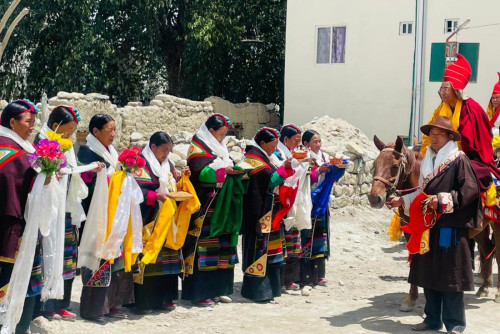
  • Witness the unique Tibetan-influenced culture, traditions, and lifestyle untouched by modernity.
  • Enjoy panoramic views of Annapurna, Dhaulagiri and Nilgiri Himal ranges.
  • Discover mysterious caves, chortens, prayer walls, and sacred Gompas across Mustang.
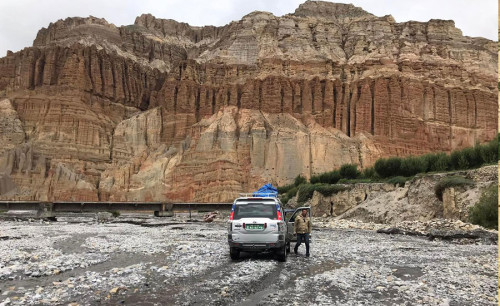
  • Experience the harsh yet stunning landscapes of the rain shadow region with dramatic cliffs and gorges.
  • Visit the sacred site of Muktinath, a pilgrimage for both Hindus and Buddhists.
  • Trek through remote villages like Yara and Ghara, where matriarchal traditions still exist.
  • Journey with HDT’ s experienced guides and porters, ensuring safety and cultural insights.

Upper Mustang Trek Short Itinerary

DayItinerary
Day 1Arrival in Kathmandu and transfer to the hotel
Day 2Sightseeing in Kathmandu and trekking preparation
Day 3Drive to Pokhara
Day 4Flight to Jomsom (30 mins) and drive to Kagbeni (40 mins)
Day 5Trek to Chele
Day 6Trek to Ghiling via Ranchung Cave Monastery
Day 7Trek from Ghiling to Drakmar
Day 8Trek to Lo-Manthang via Ghar Gompa and Chogo La Pass
Day 9Exploration day at Lo-Manthang
Day 10Trek to Tsarang
Day 11Trek to Syangmochen
Day 12Trek to Chhusang and drive to Jomsom
Day 13Fly to Pokhara
Day 14Drive (or optional fly) to Kathmandu
Day 15Transfer to international airport in Kathmandu

History and Culture of Upper Mustang

For centuries, Upper Mustang was part of the ancient Lo Kingdom, closely tied to Tibetan culture. Lo-Manthang, its capital, still showcases the grandeur of medieval times with palaces, monasteries, and festivals. The people of Mustang follow Tibetan Buddhism, and traditions here remain largely untouched by modern influence. Travelers can witness sacred rituals, masked dances, and a way of life that has survived in one of the harshest environments on Earth.

Upper Mustang Trek Difficulty – Is it Hard?

The Upper Mustang Trek is considered a moderate trek, suitable for trekkers with reasonable fitness.

  • Altitude: The trek reaches heights above 3,800m, but gradual ascents make acclimatization manageable.

  • Trail Conditions: Paths are dry and dusty with some steep climbs, but not technically difficult.

  • Daily Walking: Around 5–7 hours per day on average.

  • Preparation: Basic cardio fitness, hiking experience, and stamina are recommended.

This trek is less about high altitude challenges and more about cultural immersion and unique landscapes.

Best Time to Visit Upper Mustang

  • Spring (March–May): Clear skies, moderate temperatures, and the famous Tiji Festival in Lo-Manthang.

  • Summer/Monsoon (June–August): Unlike other parts of Nepal, Upper Mustang is a rain shadow region, making summer trekking possible.

  • Autumn (September–November): Stable weather, crisp views, and harvest season in villages.

  • Winter (December–February): Harsh and cold; not recommended for most trekkers.

Permits and Costs for Upper Mustang Trek

Since Upper Mustang is a restricted area, special permits are required:

  • Restricted Area Permit (RAP): USD 500 per person for the first 10 days, then USD 50 per day.

  • Annapurna Conservation Area Permit (ACAP): USD 30 per person.

  • Trekkers’ Information Management System (TIMS): USD 20 per person.

A minimum of two trekkers with a registered trekking company guide is mandatory to enter Upper Mustang.

Accommodation and Food on the Upper Mustang Trek

  • Accommodation: Primarily tea houses and lodges, offering simple rooms with twin beds. In Lo-Manthang, some guesthouses are more comfortable with attached bathrooms.

  • Food: Expect traditional Nepali meals like dal bhat, Tibetan dishes like thukpa and momo, as well as tea and butter tea. Some lodges serve Western food (pasta, pancakes), but the menu is limited compared to other trekking regions.

Upper Mustang Jeep Tour vs Trekking – Which is Better?

With new jeep roads linking parts of Mustang, travelers can now choose between trekking and a jeep tour.

  • Trekking: Offers an immersive cultural experience, closer interaction with locals, and gradual exploration of landscapes.

  • Jeep Tour: Suitable for those with limited time or physical challenges, allowing quicker access to Lo-Manthang and other villages.

Both options provide breathtaking views and cultural encounters, but trekking remains the most authentic way to discover Mustang.

Upper Mustang Tiji Festival Trek 2026/2027

The Tiji Festival is a three-day Buddhist celebration held annually in Lo-Manthang. It features vibrant masked dances, chants, and rituals symbolizing the victory of good over evil. The festival attracts both locals and trekkers from around the world.

  • 2025 Dates: Mid-May

  • 2026 Dates: Early May

Joining a Tiji Festival Trek or Jeep Tour allows travelers to combine cultural immersion with the breathtaking landscapes of Upper Mustang.

Highlights of Lo-Manthang – The Walled City

Lo-Manthang is the cultural heart of Upper Mustang. At 3,700 meters, this medieval walled city offers:

  • The King’s Palace

  • Ancient monasteries such as Jampa Lhakhang and Thubchen Gompa

  • Colorful prayer flags and chortens

  • Local markets and festivals
    Exploring Lo-Manthang feels like traveling back in time
    , as its walls still protect centuries-old traditions.

What Makes Upper Mustang Different from Other Treks in Nepal?

  • Unlike green valleys of Everest or Annapurna, Upper Mustang has a desert-like terrain.

  • It offers a deep cultural journey into Tibetan Buddhist traditions.

  • The trek is possible even during the monsoon season due to its rain shadow location.

  • Lo-Manthang’s walled city and hidden caves make it unique compared to any other trek in Nepal.

Fitness and Training Tips for Upper Mustang Trek

  • Practice regular hikes carrying a backpack.

  • Do cardio exercises like cycling, running, or swimming.

  • Include strength training (squats, lunges, planks) to build stamina.

  • Acclimatize properly by walking at a steady pace and staying hydrated.

Packing List for Upper Mustang Trek

Essential gear includes:

  • Warm clothing (layers, down jacket, thermal wear)

  • Good trekking boots and socks

  • Sleeping bag (if traveling off-season)

  • Trekking poles

  • Sunglasses, sunscreen, and hat

  • Reusable water bottle and purification tablets

  • Personal first aid kit

  • Cash (ATMs are not available on the trail)

Safety, Altitude & Responsible Trekking in Mustang

  • Altitude: While the trek doesn’t go extremely high (max ~4,200m), acclimatization is still important.

  • Safety: Always trek with a licensed guide. Trails can be dusty and remote.

  • Responsible Tourism: Respect local customs, use refillable bottles, and avoid plastic waste. Support local lodges and handicrafts.

Alternative Treks and Tours After Upper Mustang

If you have more time in Nepal, combine Upper Mustang with:

  • Everest Base Camp Trek Everest Base Camp Trek is Nepal’s iconic trail.

  • Annapurna Circuit Trek Annapurna Circuit Trek is Known for diverse landscapes and Thorong La Pass.

  • Muktinath Pilgrimage – A sacred site for Hindus and Buddhists.

  • Chitwan or Bardiya National Park – Wildlife safari with rhinos, elephants, and Bengal tigers.

  • Lumbini – The birthplace of Lord Buddha.

(?) Customized Trip: 

If you're interested in extending your stay in Nepal, consider pre-booking a day's sightseeing tour in the Kathmandu Valley or a multi-day excursion to the Wildlife Safari at Chitwan National Park or Bardiya National Park. Additionally, you can indulge in other exciting activities such as an Everest Base Camp Helicopter Tour, White Water Rafting in the Trishuli River, or visiting the birthplace of Buddha in Lumbini. For more information or to customize your adventure, please don't hesitate to reach out to our office. Let the Himalayan Dream Team make your Nepal experience unforgettable!

Day to Day Itinerary

Food/Meals

Dinner

Accommodation

Hotel

Max Elevation

1335 m.

Himalayan Dream Team will pick you up at the international airport in kathmandu for your transfer to the hotel. As a welcome you will have a typical Nepalese dinner with some of the staff members. Learn about momo's and Dal bhat and do not forget to try our typical Nepalese drink with great mood of cheers.

Food/Meals

Breakfast

Accommodation

Hotel

Max Elevation

1335 m.

Start your day with a delightful breakfast at the hotel before embarking on a tour of Kathmandu’s UNESCO World Heritage Sites.

Swayambhunath (Monkey Temple): Our first stop is the ancient Swayambhunath Stupa, perched on a hilltop, offering breathtaking panoramic views of Kathmandu. This sacred site is a beautiful symbol of faith for both Buddhists and Hindus.

Pashupatinath Temple: Next, we visit Pashupatinath, Nepal’s most sacred Hindu temple and cremation site. Here, you can witness and photograph traditional Hindu rituals along the Bagmati River, immersing yourself in the local spiritual life.

Kathmandu Durbar Square: After a delicious lunch, we head to Kathmandu Durbar Square, a historic site showcasing stunning Newari architecture. Enjoy a photo session with locals in traditional attire or Hindu holy men (Sadhus), perfect for capturing unique and memorable portraits.

Vegetable and Spice Markets: End the day with a visit to the bustling vegetable and spice markets. Capture dynamic street photography of vibrant colors, energetic atmosphere, and diverse faces, providing a glimpse into everyday life in Kathmandu.

Food/Meals

Breakfast

Accommodation

Hotel

Max Elevation

822 m.

After breakfast you will drive by tourist bus to Nepal's most enchanting city, Pokhara (200km). On the route we will see more of the amazing countryside of Nepal that offers greeneries, rivers, villages, farms and beautiful mountain sceneries. In the afternoon, we will arrive. The city is famous for its magnificent views of Dhaulagiri, Manaslu, Machhapuchhare, the five peaks of Annapurna. It is the starting point for all the adventurous trekkings. Pokhara is also called the city of lakes and has numerous beautiful lakes. You can explore the most accessible and beautiful of it, Fewa Lake during the afternoon -also by taking a boat. Explore, relax and dine by this tranquil Lake Fewa. You can even do some shopping during evening hours in the colorful streets alongside the lake.

Food/Meals

Breakfast-Lunch-Dinner

Accommodation

Lodge

Max Elevation

2804 m.

In the early morning, we drive to the domestic airport and embark on a scenic flight across the Himalayas to Jomsom, the district headquarters of the Mustang Region. Here, we commence our journey either on foot or by vehicle, as this is the starting point of the Upper Mustang Trek and where you'll also meet the rest of the trekking staff. Along our initial easy trail, we are greeted by the breathtaking peaks of Nilgiri, Dhaulagiri, Tukuche Peak, and Dhampus until we reach Kagbeni, a typical Tibetan village marking the entry point to Upper Mustang.

Food/Meals

Breakfast-Lunch-Dinner

Accommodation

Lodge

Max Elevation

3050 m.

Our journey starts with the usual permit check up and then we are really off onwards to the riverbank of Kaligandaki. During this walk we will stop at scenic picturesque places along the sandy and windy trails. First we reach the village of Tangbe with its narrow alleys amongst white washed houses, fields of buckwheat, barley, wheat and apple orchards. From there we trek forward to Chhusang and after crossing the river head up till we see the huge red chunk of conglomerate , that once broke from the cliff above, and now forming a tunnel through which the Kaligandaki flows. We head on over small ridges to arrive in Chele.

Food/Meals

Breakfast-Lunch-Dinner

Accommodation

Lodge

Max Elevation

3570 m.

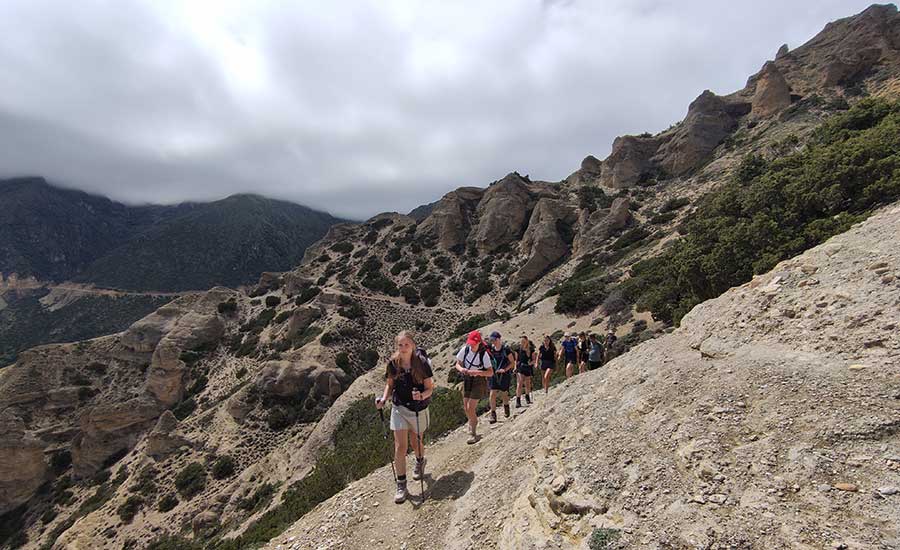
Morning after breakfast, we leave the village and climb up the unstable pebble road and will come to a plateau. We keep climbing the gentle slope and enter an area with the big canyons. We follow the trail that cut out of the cliff and after passing the canyons we will reach a small pass. Then, we move to a gentle mountain flank and continue the slightly descent and will reach Samar village surrounded by a poplar grove. We will have our lunch here. After lunch, we descend steeply to a stream, then climb up and descend steeply to another stream, then climb up to a plateau. We keep climbing up the right fork to the Chungsi-La and countering through the amazing canyons until reaching Ranchung Cave whose large stalactites resemble Rangchung (self-arisen; ie not man-made) chhorten. The Buddhist saint Guru Rinpoche is said to have meditated here in 8th century during his traveling in Mustang. Himalayan griffons nest in the surrounding cliffs. After visiting the cave, we climb gradually past pasture to Syangmochen. Again we climb up to a small pass where there is a colorfully painted square chhorten. We will see a large valley of Ghiling spreading out in front of us. We continue descending to the right towards Ghiling, cross a stream and move on along the stone walls in the farm fields. Here is two ancient monasteries and big huge chhortens and we will visit in the evening. 

Food/Meals

Breakfast-Lunch-Dinner

Accommodation

Lodge

Max Elevation

3450 m.

In the morning after breakfast, we walk through the big village and climb up the gentle slope with shrubberies and will join in mail trail. From here, a long ascent continues to Nyi-La. When we cross over this pass, we will enter the center of the Mustang, which used to be called the Lo Region. We descend the gentle slope and go around the valley ahead towards the left. We will be overlooking Ghami village and we descend steep zigzag slope and will reach the village. We will have our lunch here. After lunch, we leave the village and cross a river using the suspension bridge. We climb onto the terrace and pass along the longest Mani Wall in Mustang. The effect of the erosion on the cliff ahead attracts attention by its strange forms and the varieties of colors such as red, blue, white, etc. it is like a Mandala painted on the cliff. We keep going in level trail passing the big chhortens and cross a stream. Then, we keep walking along the upstream through the terraced fields until reaching Drakmar.


Food/Meals

Breakfast-Lunch-Dinner

Accommodation

lodge

Max Elevation

4320 m.

After breakfast, we leave the village and climb a steep gully that leads to alpine meadows and a plateau. The trail crosses a valley to a ridge and then descends to Ghar Gompa (Lo Gyaker), one of the oldest monasteries in Mustang, linked to the Nyingma tradition. After visiting the Gompa, we descend to a wooden bridge and climb up again to a plateau. From there, we walk through a grassy valley and continue gradually towards Chogo La Pass, the highest point of this route. After crossing the pass, the trail descends past cairns and ridges, giving the first views of Lo-Manthang. Finally, we follow herders’ trails until reaching the ancient walled city of Lo-Manthang.

Food/Meals

Breakfast-Lunch-Dinner

Accommodation

Lodge

Max Elevation

3840 m.

Today, we will acclimatize and immerse ourselves in the wonders of Lo-Manthang, a historic gem located about 50 kilometers from the Tibetan border. Historically, it served as the central trading hub for salt and textiles between Nepal and Tibet, with mules still used to transport goods from Tibet.

The city is renowned for its impressive 6-meter high wall, which encloses a captivating array of cultural and religious landmarks. The fortified city boasts beautiful towers at each corner, adding to its charm and historical significance.

Key landmarks within Lo-Manthang include the Thubchen Monastery, the King's Palace, a museum, the Jampa Monastery, and traditional Thangka painting workshops. Approximately 900 Lo families reside here, maintaining a close-knit community that follows the Bonpo form of Tibetan Buddhism, marrying within their community and rarely migrating elsewhere.

Remarkably, Lo-Manthang remained closed to outsiders until the 1990s. Even now, access is limited to 1000 visitors per year, with entry permitted only through authorized trekking agencies. After a day of exploration and absorbing the unique culture of Lo-Manthang, we will return to our accommodations for a well-deserved rest.

Food/Meals

Breakfast-Lunch-Dinner

Accommodation

lodge

Max Elevation

3560 m.

In the morning after breakfast, we leave the castle village of Lo-Manthang and cross a small stream. Then, we gradually climbing steep sandy slope until Lo-La Pass from where we see the last view of ancient wall city of Lo-Manthang. We keep walking across the wide plain ahead with viewing the numerous caves on the terrace’s rock face. We continue the trail passing the big isolated chhorten that marks the boundary between Lo-Manthang and Tsarang till Tsarang Khola. We cross by an iron bridge and climb up until reaching Tsarang Village. We will have our lunch. After lunch, we visit the huge five-storey white Tsarang Palace (fortified palace) and the 14th century Gompa are perched on the edge of Kaligandaki gorgr at the eastern end of the village

Food/Meals

Breakfast-Lunch-Dinner

Accommodation

lodge

Max Elevation

3560 m.

Morning after breakfast, we start our trek from our camp site and exit from the village passing huge chhorten. The trail goes a long gentle ascent until reaching to a ridge and after traverse the route down a rocky gully until reaching in Ghami passing again spectacular Mani Wall in Nepal. We will have our lunch here. After lunch, the trails continue steep up till Ghami-La and again a long gentle ascent brings to us on Nyi-La. Then, we climb down to Tamagaon and continue a steep set of switchbacks down a rocky canyon leads to a stream, then the trail climbs to a huge painted chhorten before rejoining the Ghiling trail near the ridge. We cross the small pass and descend to a Syangmochen.

Food/Meals

Breakfast-Lunch-Dinner

Accommodation

lodge

Max Elevation

2950 m.

In the morning after breakfast, we walk short level trail and steep climb up until reaching Yamdo-La. Then, we slightly climb down to Bhena. After passing the hamlets, namely Yamdo and Bhena, a long descent start to Samar crossing small streams. We will have our lunch here. After lunch, we continue the trail passing the big canyons and we reach in Tsaile. After that, we steep descend to the Kaligandaki River and cross by an iron bridge, then continue the trail along the Kaligandaki River until reaching Chhusang and drive to Jomsom.

Food/Meals

Breakfast

Accommodation

Hotel

Max Elevation

822 m.

After breakfast, we head to the airport for our flight back to Pokhara. This 30-minute scenic journey flies between the towering Annapurna and Dhaulagiri mountains. Upon landing in Pokhara, our guide will take us to a lakeside hotel. There, we'll relax by the lake and reflect on the incredible memories from our trek.

Food/Meals

Breakfast

Accommodation

Hotel

Max Elevation

1335 m.

There is a choice between a 25-minute flight to Kathmandu or, we start our 200 kilometers drive by tourist bus back to Kathmandu. In both cases you can enjoy the scenery, but from the car you will witness the beauty of Nepali nature far more better when you drive along the Trisuli river. On arrival in Kathmandu, you will be transferred to your hotel. 

Food/Meals

Breakfast

Max Elevation

1335 m.

After breakfast or lunch, depending on your flight time, we will transfer you to the international airport or if you leave by evening, you can put your luggage at the Hotel and enjoy the city one final day


Services Included on Price

Service Includes

  • Arrival and transfer to and from the international and domestic airports in Kathmandu and Pokhara
  • Authentic Nepali-style welcome dinner upon arrival in Kathmandu
  • 4 * Hotel accommodation with bed and breakfast provided in Kathmandu and Pokhara
  • Round-trip airfare from Kathmandu- Pokhara, Pokhara Jomsom, Jomsom – Pokhara -and Pokhara – Kathmandy, including airport departure taxes.
  • All standard meals during the trek (Breakfast, Lunch, and Dinner), including seasonal fruits
  • Experienced, first-aid trained, government-licensed, English-speaking trekking guide
  • Permits for Annapurna Conservation Area (ACAP) and Trekkers’ Information Management System (TIMS)
  • Restricted Area Permit (RAP) at a cost of US $500 per person
  • Porters during the trek for luggage carrying (1 porter for every 2 clients)
  • Wages, accommodation, meals, gear, insurance, and medications for all staff
  • All administrative expenses and government taxes
  • All the ground transportation by private vehicle

Service Excludes

  • International flights
  • Lunch and dinner in Kathmandu and Pokhara
  • Nepal entry visa, easily acquired upon arrival at the airport in Kathmandu (USD 50 for a 30-day visa)
  • All beverages
  • Entrance fees for any monasteries visited during trekking
  • Personal trekking equipment, travel and medical insurance, helicopter rescue, and personal expenses
  • Tips for staff (guide/porter and driver)
  • Any other expenses not mentioned in the inclusive section above


Altitude Graph

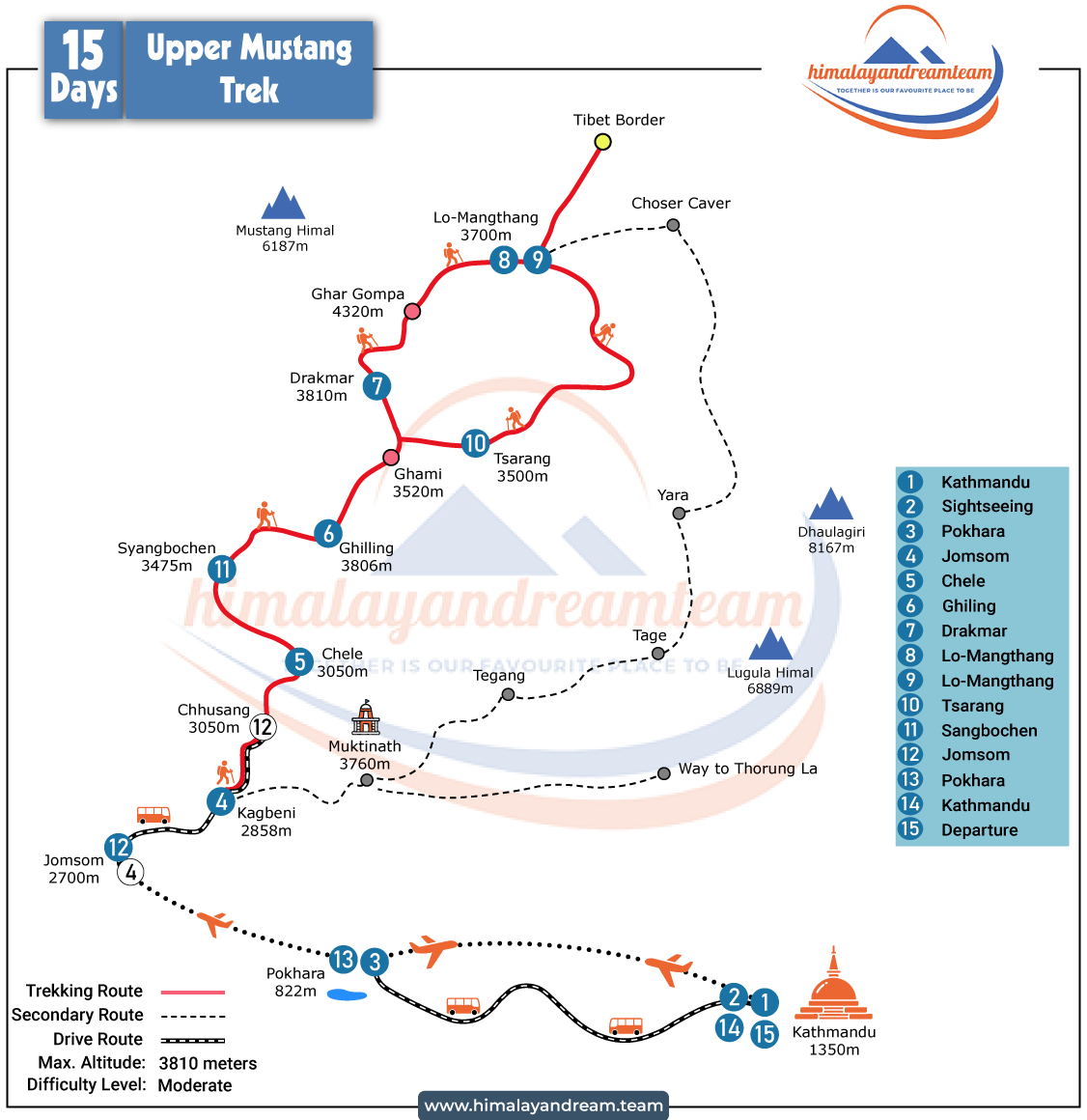
Route Map

Upper Mustang Trek route map

Frequently Asked Questions for Upper Mustang Trek

Culture

The Upper Mustang Trek explores the former Kingdom of Lo, offering a stark desert landscape, deep canyons, and an ancient Tibetan culture largely preserved due to its historical isolation.

Key highlights include the walled city of Lo Manthang, ancient monasteries like Lo Gekar and Thubchen, stunning views of Nilgiri and Dhaulagiri, and the Tiji Festival in May.

Respect local customs by dressing modestly, removing shoes before entering monasteries, and not photographing people without permission.

General Information

This trek is considered moderate. It doesn’t involve high altitudes as most of the trek is below 4,000 meters, but the terrain can be rough and windy.

Typically, the trek takes about 10 to 14 days, depending on the specific route and stops you choose to make.

The best time to visit Upper Mustang is from March to early November, with peak times during the dry and stable weather months of May, June, and September.

Pack for varied weather conditions: warm layers, a good quality sleeping bag, sturdy boots, a windbreaker, a sun hat, sunscreen, and a water purification system.

The trek involves moderate elevation gain, with Lo Manthang located at around 3,800 meters above sea level.

Engage in regular cardiovascular training like running, cycling, and hiking. Practice hiking on uneven terrain to prepare for the trek’s demands.

Permits & Logistics

You need a special Restricted Area Permit for Upper Mustang, which is more expensive than typical trekking permits, and an Annapurna Conservation Area Permit (ACAP).

No, independent trekking is not allowed in Upper Mustang. You must be part of an organized group with a registered guide.

Accommodation & Meals

Accommodations are generally basic teahouses. Facilities are simpler compared to popular treks in the Annapurna or Everest regions.

The food on the trek is mostly simple Tibetan and Nepalese fare, including items like dal bhat (lentils and rice), Tibetan bread, and noodles.

Payment & Cost

The cost varies significantly based on the number of days, the group size, and whether you hire porters. Expect to spend anywhere from $100 to $200 per day due to the higher permit costs.

Health & Safety

While the risk is lower than other high-altitude treks in Nepal, mild altitude sickness is possible. It’s important to acclimatize properly and stay hydrated.

Client Reviews

Book Now Inquiry

Similar Packages

Enjoy the popular trekking and tour packages in Nepal Himalayas. 2026.